Before and after
The same closet, before and after
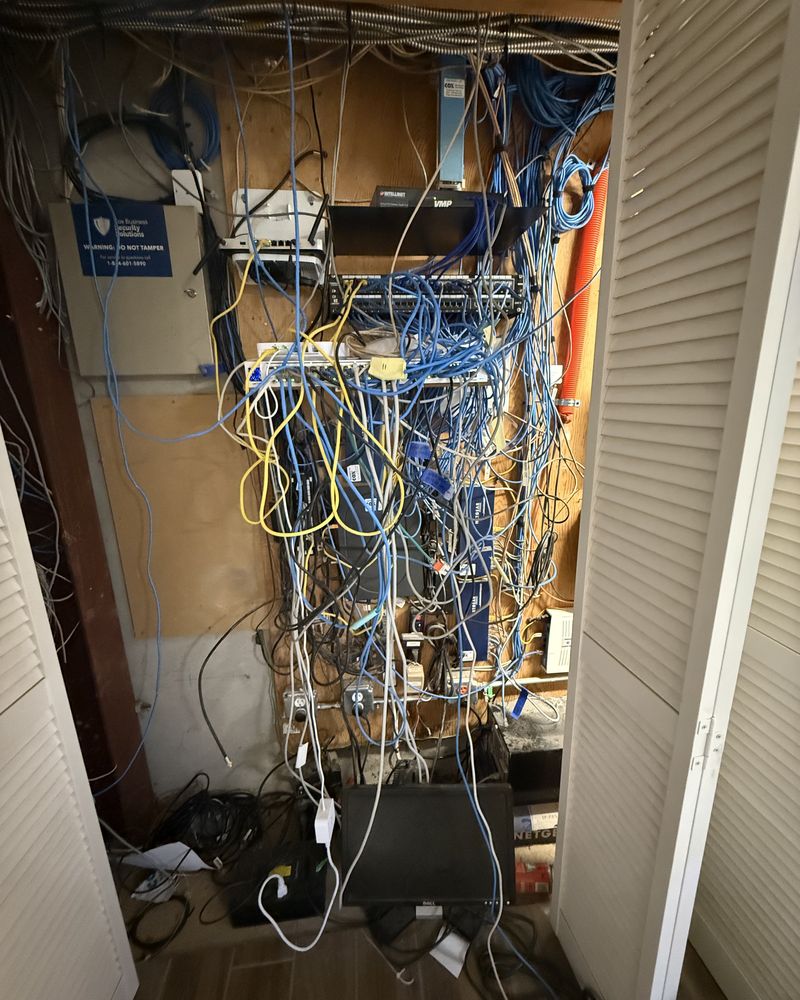
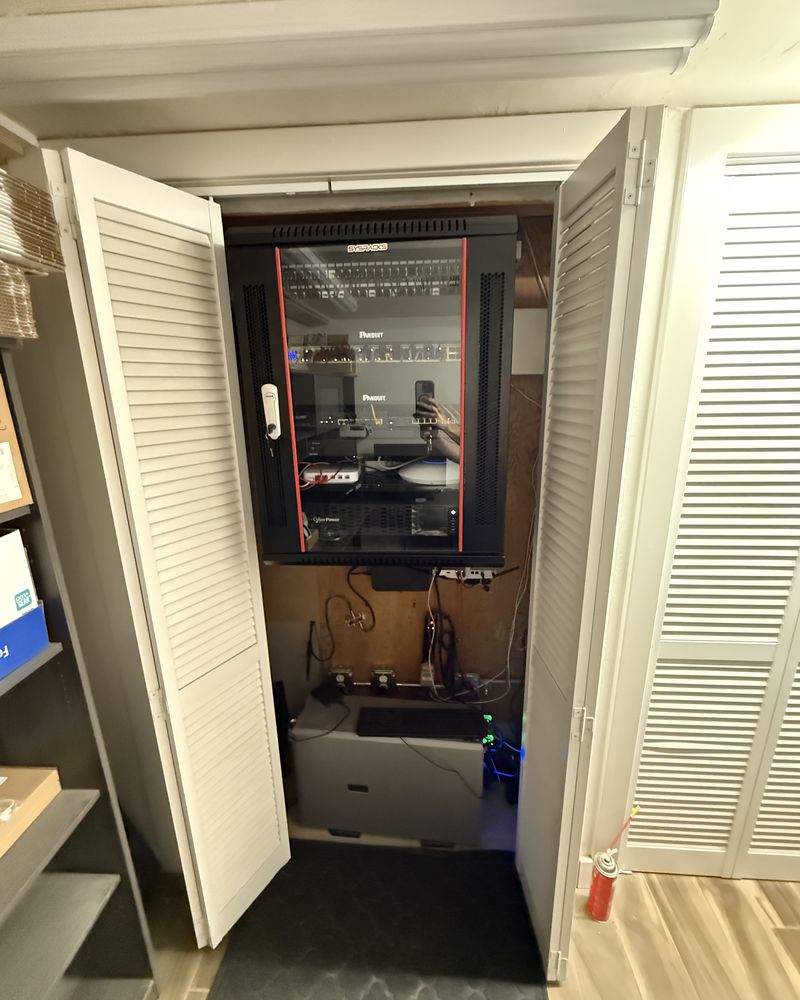
Two hundred identical white cables and nobody left who knows what serves what. We audit it, trace it, re-terminate what is failing, re-patch it in an order that makes sense, label every run at both ends, and hand you the documentation. Cutovers happen after hours.
Open the door and it is a wall of cable. Two hundred identical white patch cords, none of them labeled, half of them three feet too long and looped into a nest that hangs off the front of the rack and covers the switch ports. Somewhere in there is a fifteen-year-old patch panel wired in whatever order the installer worked in that week. Behind it, a bundle of cable that goes to a wall that no longer exists.
Nobody in the building knows what serves what. The guy who did know left in 2019. So when the conference room drops off the network before a client call, your IT person is standing in that closet with a toner, unplugging cables one at a time and walking to the other end of the building to see what went dark. A two-minute fix becomes an afternoon. Multiply that by every move, add, and change you make in a year, and the closet is quietly one of the most expensive things you own.
It gets worse in a way you cannot see, too. That nest of cable sits directly in the airflow path of your switches. Equipment that is supposed to be pulling cool air through the front and pushing heat out the back is instead breathing through a blanket, running hot year round, and failing early in a way that never gets attributed to the actual cause.
This is the job we like most, and it is usually how a building meets us. A closet cleanup is small, visible, and finished in a defined window. You find out how we work before you hand anyone a bigger project.
Five steps, in this order. The first three happen without touching a live connection, which is why the disruptive part ends up being short.
We inventory what is physically in the room: rack and cabinet space, switches and their port counts, patch panels, power, the UPS, the demarc, and how much of the closet is cable that serves nothing. Photographed as found so there is a record of the starting point.
Every run gets identified end to end and matched to the room and outlet it serves. This is the slow part and it is the part everyone else skips. It is also the reason the finished closet is useful instead of just tidy.
Failing jacks and punchdowns get redone, damaged ends get replaced, and abandoned cable comes out of the rack and the ceiling. Runs get tested as we go so we know what we are working with before anything moves.
Patch panels reordered logically by area rather than by install history, patch cords cut to actual length, routed through cable management horizontally and vertically, and pulled out of the airflow path. This is the after-hours block.
Every run labeled at both ends, at the drop and in the closet, under one consistent scheme. Test results, a port map, the list of anything found failing, and photos of the finished rack all go to you.
Once you start testing runs that have never been tested, some of them fail. A jack punched down wrong in 2012 that has been limping along at a fraction of its rated speed. A run a remodel crew put a drywall screw through. A cable pinched behind a rack that has been intermittent for years and got blamed on the switch. This is normal. On a closet that has never been cleaned up, we expect to find a handful.
Here is how we handle it. We document what failed and what it would take to fix or replace each one, and we bring that list to you before we do anything about it. You decide what gets fixed now, what waits, and what gets left alone. Nothing gets added to the invoice quietly, and we do not use a cleanup as a pretext to sell you a re-cable. If the honest answer is that eight drops are bad and the other ninety are fine, that is what the report says.
The disruptive work happens after hours. Audit and trace during the day, re-patch on an evening or a weekend, in blocks, with a rollback plan for each block. Your staff comes back Monday to a working network, not a project in progress.
Not during business hours. The audit, the trace, and the prep work can happen during the day because none of it touches a live connection. The re-patch is the part that unplugs things, so that moves to an evening or a weekend, and we work in blocks with a rollback plan for each one. Your staff should walk in the next morning to a network that behaves exactly as it did the night before, just in a closet that finally makes sense.
A single closet with 48 to 96 ports is often one long evening plus a day of audit work ahead of it. A building with an MDF and several IDFs is a phased project, one closet at a time, so the risk stays small and you keep working between phases. The walkthrough is where we count ports, look at what is actually in the rack, and give you a real schedule instead of a guess.
We tell you. A cleanup almost always surfaces a handful of runs that fail testing, were terminated badly, or were damaged during some past remodel, and that is a normal outcome rather than a surprise. We document what failed, tell you what it would take to fix or replace each one, and let you decide. We do not quietly add them to the invoice and we do not replace cable you did not approve.
Two reasons, and neither is cosmetic. Accumulated dead cable in ceilings and closets is a fire code concern because unused communications cable is generally required to be removed rather than left in place. It is also an airflow problem: a rack packed with cable that serves nothing blocks the path that is supposed to be moving heat away from your switches. Pulling it out makes the closet safer, cooler, and far easier to work in.
A closet where every run is labeled at both ends, at the drop and in the rack, patch panels ordered logically instead of in the order someone happened to install them, tested results for the runs we touched, a written list of anything found failing, and photos of the finished rack. Your IT team, or the next contractor after us, can trace any drop in seconds without pulling a ceiling tile.
When the audit says the answer is new cable, not new patch cords. Cat6 and Cat6a runs, labeled at both ends and tested.
Structured cabling →Backbone between the MDF and your IDFs when copper cannot make the distance. Direct burial and aerial infrastructure experience.
Fiber optics →Camera and recorder cabling that lands in the same closet, terminated and labeled to the same standard as everything else.
Camera systems →The approach changes with the building. Pick the one closest to yours to see how we handle it.
Seriously. Open the door, take a picture, and call us. We will schedule a walkthrough, count the ports, and tell you what it takes to make that room usable again.